



Lacquered or laminated fronts — which to choose? After hundreds of kitchens, we have the answer
This question comes up in our factory several times a week. The customer sits at the 3D design, looks at two variants side by side and asks: lacquer or laminate?
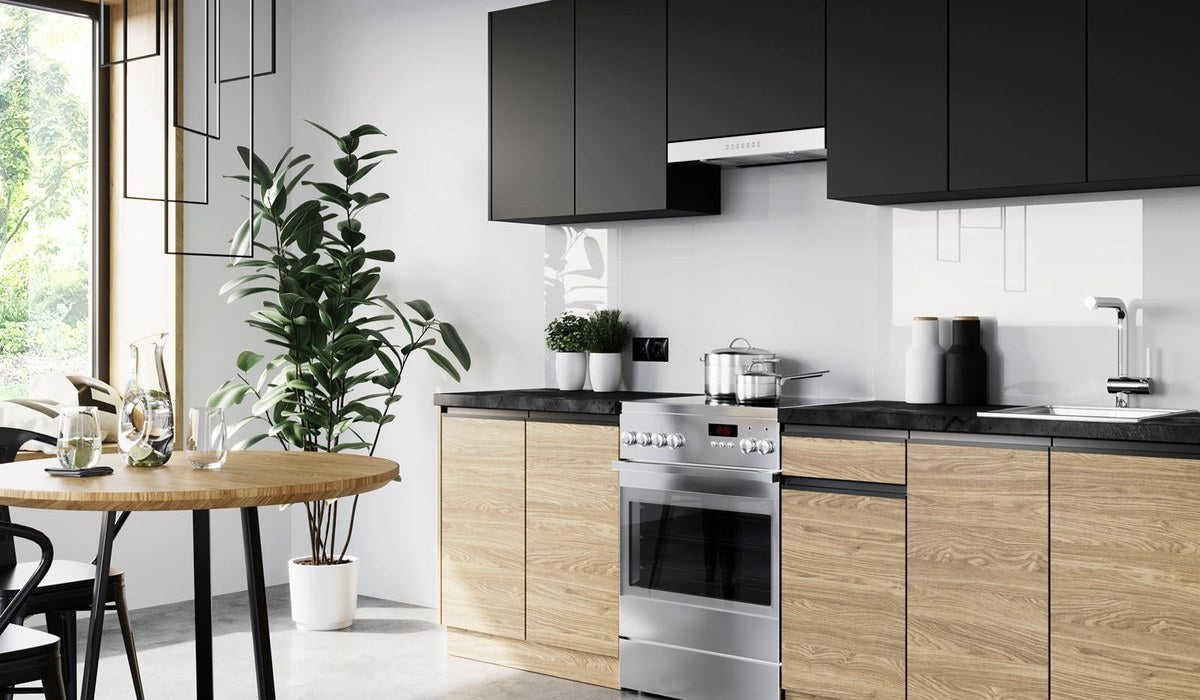
Over more than 20 years of producing bespoke kitchens in Elbląg we have installed hundreds of kitchens with both types of fronts. We know what holds up beautifully after ten years, what breaks after three, and for whom each of them is the right choice. In this article we say it plainly — without promoting one solution as "the only right one".
What actually is a kitchen front?
The front is the part of the kitchen you see and touch every day — the doors of the upper and lower cabinets, the drawers, the panel under the worktop. What impresses your guests and what you will be wiping soup splashes off for the next 15 years.
To put it simply: the carcass (the box) is hidden inside and always has a similar construction. The front is an aesthetic and functional choice at once — and it is responsible for the lion's share of the cost of a kitchen.
Lacquered fronts — what does that mean?
A lacquered front is an MDF board covered with a layer of polyurethane or acrylic lacquer, applied and cured under factory conditions. The result: a uniform, deep surface — matt or high gloss — in any colour from the RAL or NCS palette.
The advantages of lacquered fronts
- Appearance. A depth of colour and uniformity of surface that laminate will not reproduce. In gloss — a glass-like effect. In matt — a velvety texture. In photos and in the showroom the difference is immediate.
- Colour freedom. Any shade from the RAL or NCS palette. Want a dark bottle green? A deep navy? A warm grey with a slight pink tone? Lacquer makes it possible.
- Colour durability. Lacquer does not fade from sunlight the way some laminates do. After 10 years the colour looks the same as on installation day.
- Ease of cleaning (gloss). High-gloss fronts wipe clean with a damp cloth in 10 seconds. Grease and steam do not soak into the surface.
The disadvantages of lacquered fronts
- Susceptibility to scratches. Especially in gloss — every accidental brush with a metal object leaves a mark. In matt it is better, but scratches happen too.
- Visible fingerprints (gloss). A high-gloss front looks perfect in the morning. After breakfast it looks like a board covered in fingerprints. Daily wiping is a necessity.
- Price. Lacquered fronts cost 25–45% more than laminated ones for the same kitchen size. That is a real difference in the budget of the whole project.
- Difficulty of repair. A deep scratch on lacquer is hard to repair invisibly. With laminate a damaged front can be replaced with an identical one — the colour and texture will be the same.
Laminated fronts — what does that mean?
A laminated front (also called foiled or veneered) is a chipboard or MDF board covered with PVC foil or printed melamine paper. The foil can imitate wood, stone, concrete, fabric — or be a single colour. It is bonded thermally under pressure.
Note: at Furnipark we produce fronts in veneer (PVC foil) and laminate (melamine). We do not offer vacuum-foiled fronts — that is a cheaper technology with different properties.
The advantages of laminated fronts
- Scratch resistance. A hard melamine surface is much harder to scratch than lacquer. A fork dropped on the front? Most often without a trace.
- Resistance to moisture and steam. Good-quality laminate does not swell from cooking steam, provided the edges are properly protected.
- Price. Laminate allows a bespoke kitchen on a lower budget without giving up quality of carcasses and fittings. That matters if you would rather put the money towards a worktop or appliances.
- A wide choice of decors. Imitations of wood, concrete, stone — often look surprisingly good. On wood-effect decors fingerprints are practically invisible.
The disadvantages of laminated fronts
- Appearance. Even the best laminate lacks the depth of good lacquer. Up close you can see the print structure. This is especially visible in uniform, dark colours.
- Edges. The join between the front and the edging is the weak point of any laminate. Cheap fronts delaminate at the edges after a few years. The quality of the ABS edging is crucial here.
- A limited palette of solid colours. Solid colours in laminate look flat. If you want a deep, uniform colour — you need lacquer.
What our customers choose and why
After hundreds of projects we see a clear divide — not by budget, but by lifestyle.
Lacquer is more often chosen by: people for whom the look of the kitchen is a priority, interior designers working with a specific colour from the palette, customers without small children, owners of investment flats (photos for rental look better).
Laminate is more often chosen by: families with school-age children, people who cook a lot, customers with a budget of up to PLN 25,000 for a 5-linear-metre kitchen, those who value ease of use over visual effect.
There are also mixed kitchens — lacquered fronts on the upper cabinets (more decorative, less exposed to contact) and laminated on the lower ones (touched daily, exposed to knocks and scratches). This is a sensible budget solution that we use more and more often.
Questions worth asking yourself before choosing
- Do you have children under 10? If so — seriously consider laminate or matt lacquer (scratches less visible than on gloss).
- Do you cook a lot, every day? Steam and grease are merciless on gloss. If you cook often — matt or laminate.
- Do you care about a specific colour from the RAL/NCS palette? Laminate will not reproduce it — you need lacquer.
- What is your budget for the whole kitchen? If you have PLN 20,000–25,000 for a 5-linear-metre kitchen with a worktop and appliances — laminate will let you keep the quality of fittings and carcasses. Lacquer at that price will require compromises elsewhere.
- How long do you plan to live in this place? For 10+ years — the investment in lacquer pays off. For 3–5 years before selling — a solid laminate does the job too.
A few words on durability — from our experience
The most common complaints we have seen over 20 years:
- Gloss lacquer: scratches from metal objects, dulling in frequently touched spots with poor care, lacquer peeling with badly calibrated hinges (the front slamming too hard).
- Laminate: delamination at the edges after 5–8 years (with cheap edging), foil cracking at the corners on fronts cut at an angle, fading of light colours with intense sunlight through a window.
The practical conclusion: quality of workmanship matters more than the choice of material itself. Cheap lacquer will fail faster than good laminate. Cheap laminate on cheap edging will be ruined before good lacquer even has a chance to scratch.
Summary — what for whom
| Matt lacquer | Gloss lacquer | Laminate | |
|---|---|---|---|
| Appearance | ★★★★★ | ★★★★★ | ★★★☆☆ |
| Scratch resistance | ★★★☆☆ | ★★☆☆☆ | ★★★★★ |
| Ease of cleaning | ★★★★☆ | ★★★☆☆ | ★★★★☆ |
| Price | higher | higher | lower |
| For whom | Families, intensive use, design-conscious | Showcase interiors, few children | Families with children, lots of cooking, smaller budget |
Do you want to see both variants before deciding?
In our showroom in Elbląg we have samples of lacquered and laminated fronts — you can touch them, see them in natural and artificial light, wipe them with a damp cloth. This often changes a decision made earlier "by eye" from the internet.
We prepare a 3D design of your kitchen in both material versions free of charge — so you can compare the visual effect before you decide.
Call: 608 517 844 — Mon–Fri 8:00–16:00
or write: kuchnie@furnipark.pl