

Lacquered kitchen fronts — what to know before ordering?
Lacquered fronts are one of the most frequently chosen materials in our kitchen factory in Elbląg. And one of the most frequently misunderstood. Customers ask us about lacquer after seeing beautiful projects on the internet — but before they place an order, they should know what they are getting and what they are not. After more than 30 years of producing bespoke kitchens we have a very concrete view on this.
What is a lacquered front?
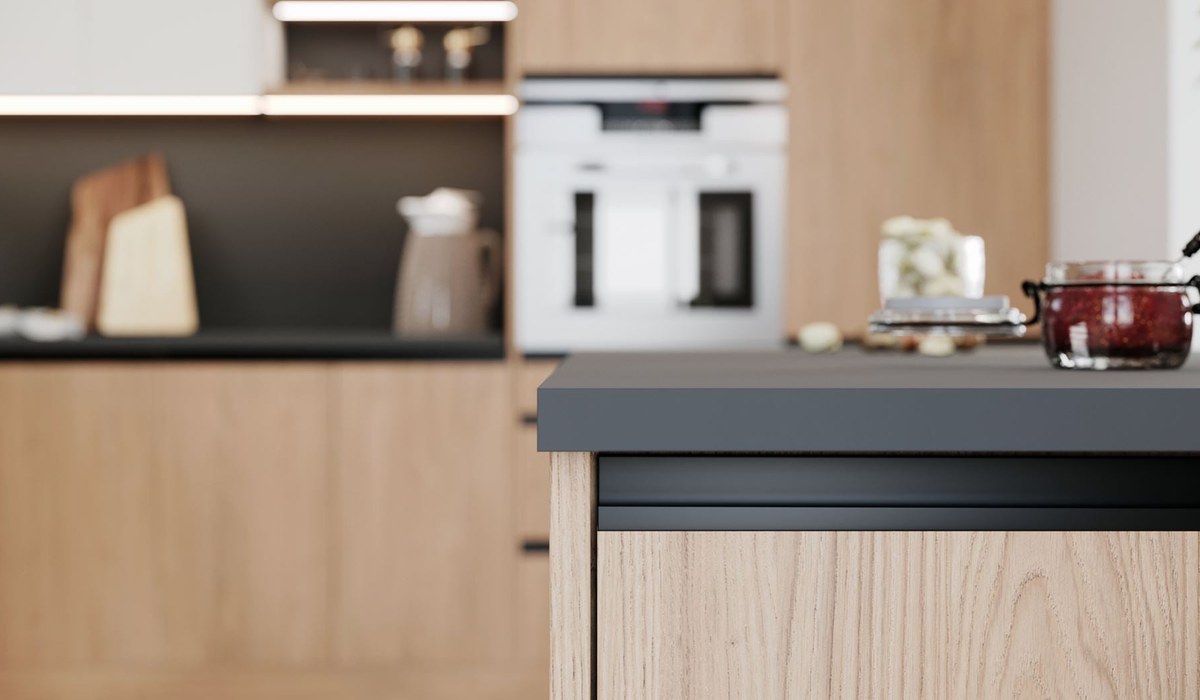
A lacquered front is an MDF board (medium density fibreboard) covered with a layer of polyurethane lacquer, applied and cured under factory conditions. The process looks like this: the cut MDF elements are sanded, primed, lacquered in several coats, cured in an oven, sanded again and lacquered. The final result is a uniform, hard surface with no visible structure of the base material.
Depending on the degree of gloss we speak of a matt lacquered front (low reflection, a velvety texture) or a high-gloss lacquered front (a mirror reflection, a glass-like effect). Both are made with the same technology — they differ in the composition of the lacquer and the way it is finished.
In our Premium Lacquered line we offer three stylistic variants: Modern (handleless, simple forms), Classic (with handles, timeless design) and Handleless (a routed groove system or push-to-open). Each of them is available in the colours from our material sample set.
The advantages of lacquered fronts — what really sets lacquer apart
Depth and uniformity of colour
This is what no other material will reproduce. A good matt lacquer has a depth you can see and feel under your finger. Gloss lacquer in a dark colour looks like liquid metal. No PVC foil, no laminate — even an expensive one — gives the same surface quality. In photos and in reality the difference is immediate.
A wide palette of colours
You choose from a wide palette of colours from our material sample set — from classic whites and greys, through dark bottle green and deep navy, to warm shades with a pink tone. This is still a considerably wider range of colours than in a typical laminate — but unlike some manufacturers we don't promise any colour from the entire RAL or NCS palette. We show real samples that you can see and touch in our showroom before ordering.
Colour durability over time
Lacquer does not fade. After 10 years of intensive use the colour of a lacquered front looks the same as on installation day — provided it is not exposed to direct, intense sun for many hours a day. Good lacquers have additional UV filters. Some PVC foils yellow or fade more noticeably in sunlight.
Ease of cleaning (matt and gloss)
A lacquered surface does not absorb grease or dyes. A damp microfibre cloth removes dirt in an instant. You don't need any special products — water with a drop of washing-up liquid is enough. That matters in a kitchen, where the fronts are exposed to splashes and steam every day.
The disadvantages of lacquered fronts — with no beating around the bush
Susceptibility to scratches
This is the biggest problem with gloss lacquer. Every brush with a metal object — keys, appliances, even jewellery — can leave a scratch visible in the reflection of light. Matt lacquer is noticeably better in this respect, but it is also not as scratch-resistant as a hard melamine surface.
If you have small children or live with people who treat the kitchen intensively, scratches on gloss lacquer will appear quickly. This is not a manufacturing fault — it is a property of the material.
Fingerprints (gloss)
Dark gloss lacquer is a beauty and a curse at once. After a family breakfast the fronts look as if they have been in use for a year. Daily wiping is a necessity, not an exaggeration. Matt lacquer doesn't have this problem — on a velvety surface fingerprints are practically invisible.
Price
Lacquered fronts are more expensive than laminated ones — for the same kitchen size the difference is usually 25–40% on the fronts alone. For a 5-linear-metre kitchen that is a real amount. It is worth knowing this when planning your budget, so you don't have to give up quality of carcasses, worktops or fittings in favour of lacquer.
Difficulty of repair
A deep scratch on lacquer is hard to repair invisibly — especially with a less commonly chosen colour from the sample set. Replacing a single front after years can be difficult, because lacquers from different production batches may differ slightly in shade. Laminate is simpler in this respect: a front replaced on the basis of the colour catalogue number will be identical.
Matt or gloss lacquer — which to choose?
From our experience: matt wins on practicality, gloss wins on spectacle.
Matt lacquer hides scratches, doesn't collect fingerprints, is nicer to the touch and looks good through years of intensive use. It is chosen by people who want a beautiful kitchen without the need for daily wiping.
Gloss lacquer makes an impression. In dark colours — especially. It is the choice for a kitchen where the visual effect is a priority and use is moderate. It works beautifully in living rooms combined with a dining area, where the kitchen is part of the scenery rather than a daily battlefield.
| Matt lacquer | Gloss lacquer | |
|---|---|---|
| Appearance | Elegant, subtle | Spectacular, mirror-like |
| Fingerprints | Practically invisible | Very visible, daily wiping |
| Scratches | Less visible | Clearly visible |
| Cleaning | Easy | Easy, but more frequent |
| For whom | Families, intensive use | Showcase interiors, lower use |
The durability of lacquered fronts — from 30 years of production
A good lacquered front, with proper care, serves 15–20 years without losing its appearance. We see such kitchens at customers who ordered from us over a decade ago — and they look like new.
The problems we have seen over the years:
- Lacquer peeling at the edges — the result of poor-quality MDF or an error in edge processing. In our fronts we use MDF with a density of at least 750 kg/m³ and we rout the edges before lacquering.
- Cracking with large changes in humidity — rare, but possible with low-quality MDF. A lacquered front should be protected from excessive moisture in the sink area.
- Dulling of gloss in areas of intense contact — natural after several years of intensive use. It can be limited by using the right cleaning products.
The conclusion: the durability of lacquer depends 50% on the quality of production and 50% on daily care. Lacquer on poor MDF, without proper priming, will be ruined after 3 years. Good lacquer on good MDF will survive several renovations.
How to care for lacquered fronts?
The rules are simple and don't require special products:
- Daily or every few days: a damp microfibre cloth, without abrasives.
- Greasy dirt: a few drops of washing-up liquid in water, wiping in a circular motion.
- Avoid: products with chlorine, powders and abrasive pastes, sponges with a rough side, steam mops aimed at the fronts.
- With gloss: after each wiping, go over it with a dry microfibre cloth so as not to leave streaks.
When we recommend lacquered fronts — and when we advise against them
We recommend lacquer when:
- You care about a specific, unusual colour from our sample set that laminate won't reproduce.
- The kitchen is an important element of the whole living room's decor and you are working on the design with an architect.
- You have a budget that doesn't force compromises on fittings, worktop and appliances.
- You are prepared for regular wiping (especially with gloss).
We advise against lacquer when:
- You have small children under 6–8 years old — scratches will appear quickly and will hurt.
- Your budget is tight — it is better to choose a good laminate and put the savings towards better hinges, drawers and a worktop.
- You choose gloss but don't like daily wiping.
Do you want to see lacquered fronts in person?
In our showroom in Elbląg we have full sample sets of the Premium Lacquered line — matt and gloss, in various colours. You can touch them, scratch them (really, we have a special sample for this), see the difference between the shades in natural and artificial light.
We prepare a 3D design of your kitchen in lacquer free of charge — before you decide, you will see how exactly your space will look, not a photo from a catalogue.
Call: 608 517 844 — Mon–Thu 8:00–18:00, Fri 8:00–15:00
or write: kuchnie@furnipark.pl