



Laminated kitchen fronts — durability and practicality in everyday use
Laminated fronts are the most frequently chosen type of kitchen front in Poland. And not without reason — they combine good durability, a wide choice of patterns and a reasonable price. But like any material, they have their limitations, which are worth knowing before ordering. In our factory in Elbląg we have been producing bespoke kitchens for over 30 years, and in that time we see everything — the good and bad sides of laminate in everyday use.
What is a laminated front?
A laminated front is a board (MDF or chipboard) covered with a layer of melamine laminate. Melamine laminate is paper impregnated with melamine resin, pressed under high temperature and pressure directly onto the surface of the board. The result is a hard surface integrated with the board — not glued on separately like PVC foil.
An important distinction that is often glossed over in sales:
- Melamine laminate (HPL/CPL) — a harder, more durable technology, a higher segment.
- PVC foil (foiling) — a thinner coating, cheaper production, a lower segment.
- Vacuum foiling — a method of wrapping PVC foil around routed patterns (doors with profiling). A completely different technology from laminate.
In our factory the Struktura line is based on fronts made of melamine laminate — the more durable option we are known for. We don't offer vacuum-foiled fronts.
The advantages of laminated fronts — why most customers choose them
Scratch resistance
This is the most important advantage of laminate in everyday use. A hard melamine surface is noticeably harder to scratch than lacquer. A fork dropped on the front, keys left on the worktop, children's toys — laminate takes this without a trace or with minimal damage. For families with children this is an argument not to be underrated.
Ease of everyday care
Laminate doesn't require daily wiping to a shine. On wood-effect and textured decors fingerprints are practically invisible. Once a week a damp cloth is enough to keep it clean. With gloss lacquer — you wipe every day.
A wide choice of decors
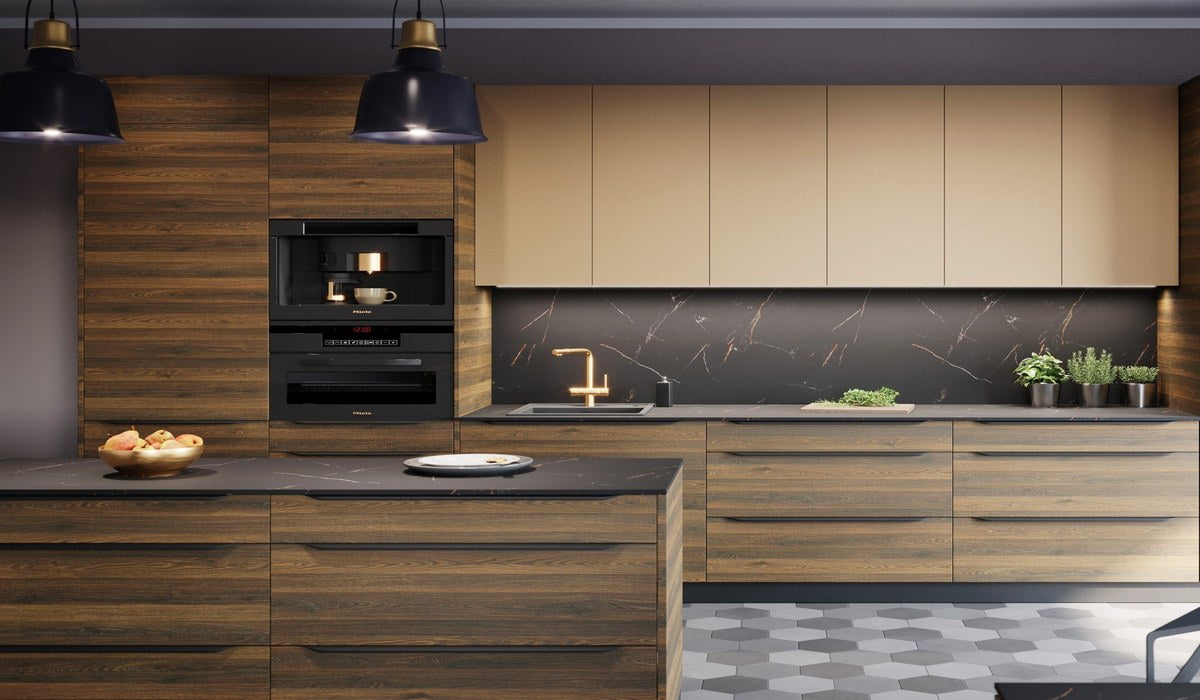
Imitations of oak, walnut and exotic species of wood. Concrete, stone, fabrics. Single-colour shades. A good laminate in a wood decor looks surprisingly natural — especially when combined with worktops of the same texture. With textured decors the feel to the touch is very close to natural wood.
Price
Laminated fronts cost 25–40% less than lacquered ones for the same size. For a 5-linear-metre kitchen that is an amount you can put towards better hinges by Blum or Hettich, tandembox drawers instead of ordinary runners, a thicker worktop or a better sink. This is a strategic argument — not just a budget one.
Ease of replacement
If in 10 years one front gets damaged, you can order an identical one — on the basis of the colour catalogue number. A good manufacturer keeps colours in the standard range for many years. With lacquer, reproducing the colour from another batch is more difficult.
The disadvantages of laminated fronts — with no embellishment
Appearance — it won't reach the depth of lacquer
This is the limit laminate won't cross. Even a very expensive laminate in a uniform dark colour will, up close, have a different depth from matt lacquer or acrylic. The difference is most visible with uniform, deep colours — black laminate vs black lacquer are two different visual categories. On wood-effect and textured decors this difference is minimal.
Edges — the weak link of cheap fronts
The join between the laminate and the edge banding is the point that determines the durability of the whole. Cheap fronts with a thin ABS edge or paper edging delaminate at the edges after 4–7 years of use, especially with changes in humidity. A good laminated front has a thick ABS edge (at least 2 mm), carefully glued under pressure.
How to check this when buying? Run your finger over the edge of the front — if you feel a distinct ridge between the laminate and the edging, that is a bad sign. A good edge is smooth and almost invisible.
Limitations with intense sunlight
Light laminate colours — especially whites and beiges — can yellow with prolonged, intense sunlight through a window. Polyurethane lacquer with a UV filter is more durable in this respect. If the kitchen has a large window facing south and you don't have blinds — that is worth knowing.
Single-colour shades look flat
If you want a kitchen in deep grey or navy — a single-colour laminate will look flat compared to lacquer. On textured decors (e.g. wood, concrete) this flatness is not a problem, because the effect comes from the pattern, not from the depth of colour.
Melamine laminate vs PVC foil — a difference worth knowing
Both types of front exist on the market — and they are often sold under the common name "laminated fronts" or "foiled fronts". They differ significantly:
| Melamine laminate (HPL/CPL) | PVC foil (foiling) | |
|---|---|---|
| Method of bonding | Pressed with the board under pressure | Glued cold or thermally |
| Hardness | Higher | Lower |
| Risk of peeling | Very low | Higher with poor-quality glue |
| Scratch resistance | Higher | Lower |
| Price | Higher | Lower |
| Durability | 15+ years | 5–12 years (depends on quality) |
When you ask about the price of a laminated front and hear a very low figure — ask what technology it is. The difference in durability is significant.
Who are laminated fronts for?
From 30 years of production we know who is most satisfied with laminate:
- Families with children of any age — laminate takes daily use without drama.
- People who cook a lot and intensively — steam, grease, movement by the cooker over years. Laminate withstands it.
- Customers with a budget of up to PLN 25,000–30,000 for a kitchen — laminate lets you keep the quality of fittings, carcasses and worktops without compromise.
- Lovers of wood decor — good wood-effect laminates look natural and cope well with the kitchen zone.
- People who don't want to think about daily wiping to a shine — matt lacquer gives similar convenience, but costs more.
Caring for laminated fronts
- Daily or weekly: a damp microfibre cloth. You don't need anything more.
- Greasy dirt: water with a little washing-up liquid, a short wipe, without scrubbing.
- Avoid: abrasives, powders, hard sponges. They can dull the surface.
- The area by the sink: make sure water doesn't stand at the edges. Regularly wiping the edges of the lower fronts by the sink extends their life.
The durability of laminated fronts — a realistic assessment
A good melamine-laminated front from a proven manufacturer, with a thick ABS edge — serves 15–20 years without problems. We see such kitchens at our customers and they still look decent.
A cheap laminated front with a thin edge and PVC foil — may show the first problems after 4–6 years. Not because of poor use, but because of poor quality of workmanship.
The conclusion: laminate is only as good as the quality of its workmanship. Ask about the technology, the edging and the warranty — not just about the colour and the price.
Do you want to see laminated fronts before deciding?
In our showroom in Elbląg we have full sample sets of the Struktura line — in various wood and concrete decors and single-colour shades. You can touch the edge, check the quality of the edging, compare different patterns with each other in natural light.
A free 3D design of your kitchen in the chosen laminate decor — before you decide, you will see how your space will look, not just a 10×10 cm sample.
Call: 608 517 844 — Mon–Thu 8:00–18:00, Fri 8:00–15:00
or write: kuchnie@furnipark.pl