



A kitchen for a family with children — which fronts and worktops survive daily use
When customers with small children come to us for a kitchen, the first question is usually: "What should we choose so it survives?" It's not about a catastrophe — it's about reality: crayons, markers, knocks with a spoon, spilled juices and small hands that open and close cabinets dozens of times a day.
At Furnipark, over more than 20 years, we have made kitchens for families in every possible configuration. We know what comes back after a year with a complaint and what customers praise when the children are already fifteen. This is first-hand knowledge — we write it without embellishment.
What destroys kitchen fronts fastest
Before we get to the recommendations — it is worth knowing what you really want to protect the furniture from.
- Markers and crayons — they leave permanent marks on high-gloss lacquered fronts (they penetrate the micropores) and on laminate with a smooth structure. On matt lacquer and textured laminate they wipe off more easily.
- Knocks and dents — the edges of the fronts and the lower cabinets are especially exposed. Hard textured laminate withstands knocks better than thin lacquer on MDF.
- Greasy hands — every front collects fingerprints, but gloss shows them immediately, matt — after a longer time.
- Water and steam — the area around the sink and dishwasher are the zones of the most intense moisture. A damaged edge or a gap between the cabinet and the worktop is a path for water to reach the chipboard — and the end of the carcass within a few years.
- The force of closing cabinets — children close doors with a bang. Without a soft-close mechanism that is dozens of impacts a day transferred to the hinges and fittings.
Fronts — what to choose for a family with children
Textured laminate (wood structure or concrete) — the best choice
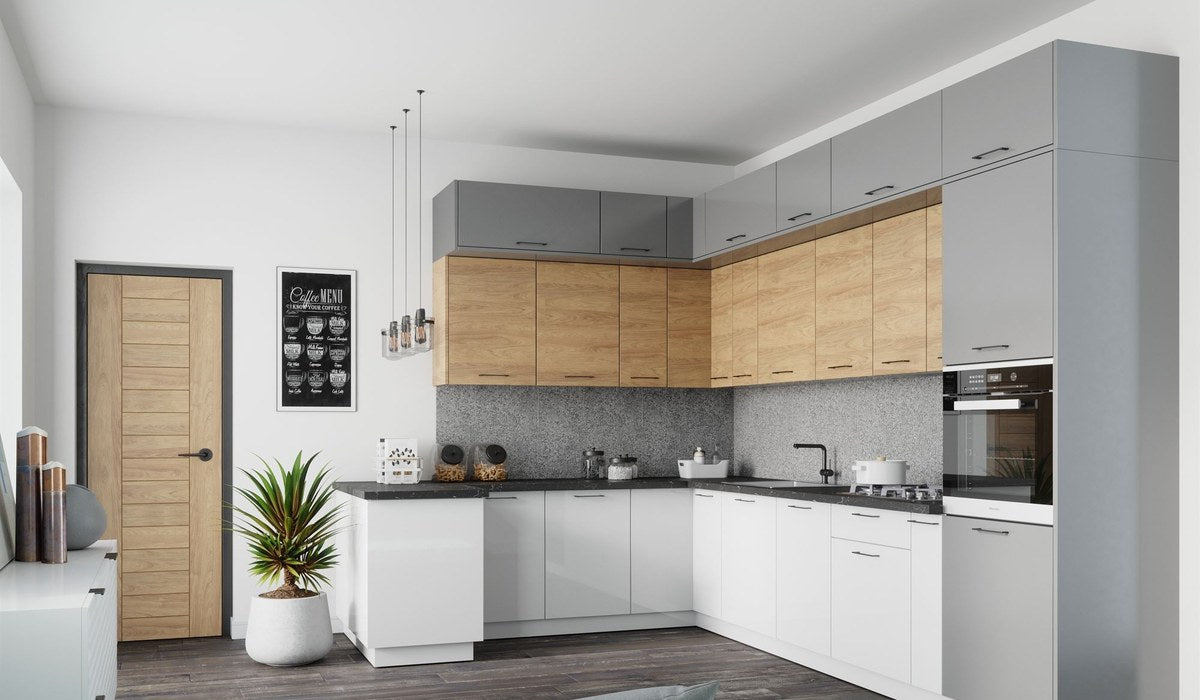
This is our number one for families with children. A hard surface, the textured finish hides small scratches and fingerprints, a marker can be washed off with a damp cloth before it dries, the edges withstand knocks better than lacquer.
Textured laminate is also cheaper than lacquered — the difference is a few thousand zloty across the whole kitchen, which can be put towards a better worktop or fittings.
Avoid: laminate in a very light solid colour — scratches and marks are more visible on it. Prefer wood-effect patterns or textured structures.
Matt lacquer — good, but more expensive
Matt lacquer is noticeably better than gloss in an environment with children — fingerprints and small marks are less visible, and the surface is easier to clean than gloss. However, matt lacquer is more susceptible to scratches from knocks than hard laminate, and more expensive.
If the budget allows and you care about the aesthetics of lacquer — choose matt, not gloss. Avoid deep black and white gloss — they show everything.
Gloss lacquer — we advise against it
Gloss is beautiful in a showroom. In a home with children, for the first few months you enjoy the effect, then you fight fingerprints, smears and scratches visible from every angle. Every touch of a finger is visible immediately. We don't recommend it for families with children under 10 years old.
Worktop — what to choose for intensive use
Quartz conglomerate — decidedly the best
No pores, very high hardness, resistance to stains (juice, coffee, grease don't penetrate the structure), easy to clean. If you're choosing something for 15–20 years of active cooking and a family with children — it's conglomerate.
The only limitation: hot pots directly on the worktop can damage it (the resin reacts to temperatures above 150°C). Use trivets — and that's it.
Natural granite — very good
Hard, resistant to scratches and heat. It requires sealing once every year or two, but otherwise maintenance-free. For families who prefer a natural material and don't want to worry about the future of the worktop.
Postforming — it will do, but with limitations
HPL laminate on postforming is non-absorbent and quite resistant to stains. The problem: the edges — scratches with intensive use leave visible marks, and damaged edges are a risk of the board delaminating on contact with water. If you choose postforming — take special care of the area around the sink.
Marble — not for families with children
Beautiful, but porous, soft and demanding. Coffee spilled and not wiped for an hour can leave a permanent mark. With children — it's not a good idea, unless you treat the kitchen decoratively.
Fittings — soft close is not a luxury, it's a necessity
With a family with children, soft close (a mechanism that slows the closing of doors and drawers) is not a premium option — it's a solution that protects the furniture. Without it, every hard closing transfers the impact to the hinges, front frames and edges. After a few years of intensive use the difference shows.
What is worth knowing about fittings for families:
- Drawers with full-extension runners — children can see what is at the back of the drawer and don't yank it looking for things. A lower risk of pulling the drawer out of the runners.
- Hinges with soft close and adjustment (e.g. Blum Clip Top) — durable and adjustable after any repositioning of the door.
- Handles instead of handleless fronts — small children have trouble opening handleless cabinets (they press and pull the fronts, not push-to-open). Handles are intuitive.
Practical design solutions for families
A lower cabinet without a bottom drawer at floor level
The lowest drawer or door is the most exposed to knocks and dirty hands. Some customers opt for a full lower build with a higher plinth strip (15 cm instead of 10 cm) — less easily accessible to small children, easier to clean.
A worktop in a uniform colour with no joins
Every joint on a worktop is a potential place for dirt and water to gather. A worktop from a single slab (possible with conglomerate and stone) is simpler to keep clean.
A build up to the ceiling eliminates hard-to-reach shelves
Empty spaces above the wall cabinets are places for dust to collect. A build up to the ceiling closes off this problem and gives extra capacity for rarely used things.
Avoid glass fronts within children's reach
Glass fronts (glazed units) look beautiful, but are prone to breaking and leave fingerprints. If you want glazed units — place them in the upper zone, out of the reach of small hands.
Our recommendation for families with children
| Element | Recommendation | Avoid |
|---|---|---|
| Fronts | Textured laminate (wood-effect or concrete texture) or matt lacquer | Gloss — any colour |
| Worktop | Quartz conglomerate or granite | Marble, light postforming by the sink |
| Fittings | Soft close on doors and drawers, full extension | The cheapest fittings without damping |
| Front colour | Wood-effect patterns, warm grey, beige — they hide marks | White gloss, deep black |
| Extras | Handles instead of handleless, a high plinth strip | Glass units in the lower zone |
The most common questions from parents
Will a crayon wash off a lacquered front?
From matt lacquer — usually yes, if you act quickly (a damp cloth). From gloss — harder, because gloss lacquer has micropores in which the pigment sets. From textured laminate — easiest, the texture doesn't hold the pigment the way a smooth surface does.
After how many years do you have to replace the kitchen with a family with children?
With a good choice of materials and fittings — the kitchen should last 15–20 years. The fittings and the postforming worktop by the sink wear out earliest. Carcasses of thick chipboard (18 mm) with good-quality edging can last much longer.
Are handleless fronts practical for children?
Push-to-open requires a different technique from a child than intuitively yanking a handle. Small children often push and pull at the same time — which doesn't open a push-to-open cabinet and can strain the mechanism. Handles are simpler for children.
How long does the project take?
Standardly 6–10 weeks from the first contact. Details: How long does it take to make a bespoke kitchen →
We will design a kitchen that will outlast your children
The 3D design and quote are free. Tell us about your reality — and we will propose solutions matched to use, not just to aesthetics.
Call: 608 517 844 — Mon–Fri 8:00–16:00
or write: kuchnie@furnipark.pl
Which kitchen worktop to choose? A comparison of materials →